Considering alternatives to Boomi?
Whether your renewal quote came in higher than expected, your data volumes have grown beyond what the pricing makes comfortable, you need richer data transformation or orchestration capabilities, or you're simply evaluating whether Boomi is still the right tool for you, this guide covers the most credible alternatives.
The goal isn't to declare a winner, but to help you match the right tool to the right use case.
What is Boomi and who is it for?
Boomi is an Integration Platform as a Service (iPaaS) that connects applications, data, and processes across cloud and on-premises environments. It’s a mature, broad-scope platform with a large connector library, a visual low-code interface, and capabilities spanning application integration, API management, data integration (via its acquired Rivery product, now Boomi Data Integration), and managed file transfer.
Boomi is a strong choice for organizations that need to connect many SaaS applications quickly and have dedicated integration specialists on staff. But as organizations grow, some consistent friction points can emerge:
-
Cost unpredictability at renewal: Can include per-connector fees, per-environment charges, and escalation clauses.
-
ETL depth: Boomi is broad by design – teams with primarily data engineering needs can find it over-scoped and often end up looking at purpose-built ETL platforms for stronger transformation and orchestration capabilities.
-
Scalability at volume: At high data volumes teams can find themselves doing significant JVM and infrastructure tuning — which is sometimes unexpected for a platform sold as SaaS.
-
Specialist dependency: Boomi can be complex, with even straightforward integrations tending to require certified specialists to maintain, creating key-person dependency that's disproportionate to the actual complexity of the work.
Note: None of these are fatal flaws, and for many organizations Boomi continues to deliver real value. But if any of these resonate, it's worth knowing what the alternatives are.
A note on iPaaS vs. data integration platforms
Not all of the alternatives below are the same type of tool — so which Boomi alternative is best for you depends on your needs.
We've broken out this list into sections - iPaaS, general data integration and ETL tools, and other specialist tools.
iPaaS platforms (Boomi, MuleSoft, Workato, Celigo) are built around connecting applications to each other. The primary unit of work is a message or event — Salesforce fires a trigger, the platform catches it and updates NetSuite. The value is in connector breadth and the speed of wiring up SaaS tools in event-driven flows.
Data integration platforms (CloverDX, Talend, and to some extent Informatica) are built around moving and transforming large volumes of data reliably. The primary unit of work is a dataset — load millions of records, validate and transform them row by row, land them in a data warehouse or downstream system. The value is in technical depth, performance at volume, and operational control over what happens to every record.
If your Boomi frustration is about SaaS connectivity costs or complexity, the iPaaS alternatives could be a closer fit. If your concerns are around data volume, ETL performance, transformation complexity, or pricing that scales with your data, the data integration platforms are where to focus.
The top iPaaS Boomi alternatives in 2026
1. MuleSoft Anypoint Platform
Best for: Large enterprises with complex API strategies and deep Salesforce investment
MuleSoft is arguably Boomi's closest enterprise iPaaS peer. Its API-first approach is a differentiator for organizations that treat APIs as products, and for those deep in the Salesforce ecosystem, the native connectivity is a significant advantage. The Anypoint Exchange (a reusable asset library) and DataWeave transformation language are well-regarded by integration specialists.
Compared to Boomi: MuleSoft tends to have a steeper learning curve and higher total cost of ownership. For straightforward data integration workloads, many teams find it over-engineered.
Consider Mulesoft if: You’re building a comprehensive API strategy, you're heavily invested in Salesforce, and you have the budget and technical team to match.
2. Workato
Best for: Business-led integration and "citizen integrator" use cases
Workato is a credible competitor to Boomi, particularly for mid-market organizations and teams looking to enable non-technical users. Its recipe-based interface is accessible to non-engineers — SalesOps, RevOps, and Operations teams can build and own integrations without a development backlog. It's also strong across the modern SaaS stack (Salesforce, HubSpot, NetSuite, Zendesk and hundreds more) and its AI-assisted workflow builder is a notable differentiator.
Compared to Boomi: Workato can be weaker on deep data engineering workloads — complex batch transformations, high-volume ETL, or granular per-record error handling.
It also uses a consumption-based pricing model based on ‘recipe runs’, meaning costs can escalate quickly as volumes grow.
Consider Workato if: you need to empower business teams to own their integrations, your primary use case is SaaS-to-SaaS connectivity, and you’re willing to trade some technical depth for better usability.
3. Celigo
Best for: Mid-market SaaS integration with ERP and e-commerce focus
Celigo is a focused iPaaS platform that’s carved out a strong position connecting ERP systems (NetSuite in particular), e-commerce platforms, and the surrounding SaaS stack. Its pre-built integration templates for common workflows — order-to-cash, procure-to-pay, inventory sync — significantly reduce time-to-value, and usability is generally rated higher than Boomi for business-side users.
Compared to Boomi: Celigo is more focused and less flexible than Boomi. For complex or high-volume data integration needs, Boomi's broader technical capability tends to win. Celigo uses a connector-based pricing model, so costs scale with the number of connections.
Consider Celigo if: you're a mid-market company with NetSuite at your core, your integration patterns are fairly standard, and you want a platform your operations team can run without dedicated engineers.
The top data integration and ETL platform alternatives to Boomi in 2026
1. CloverDX
Best for: Complex data integration, high-volume ETL, and where pricing predictability is a priority
CloverDX is a data integration platform built specifically for data engineers running complex, high-volume pipelines. Where Boomi is a broad iPaaS, CloverDX is purpose-built for the ETL/ELT use case, and that focus shows in its transformation depth, error handling model, and pricing approach.
Compared to Boomi: CloverDX is more specialized – it offers powerful transformation capabilities, providing granular control over transformation logic, data routing, and pipeline orchestration.
-
Deployment: CloverDX runs on-premise, in any cloud, or hybrid, giving teams full control over their runtime environment — important for data residency requirements and regulated industries.
-
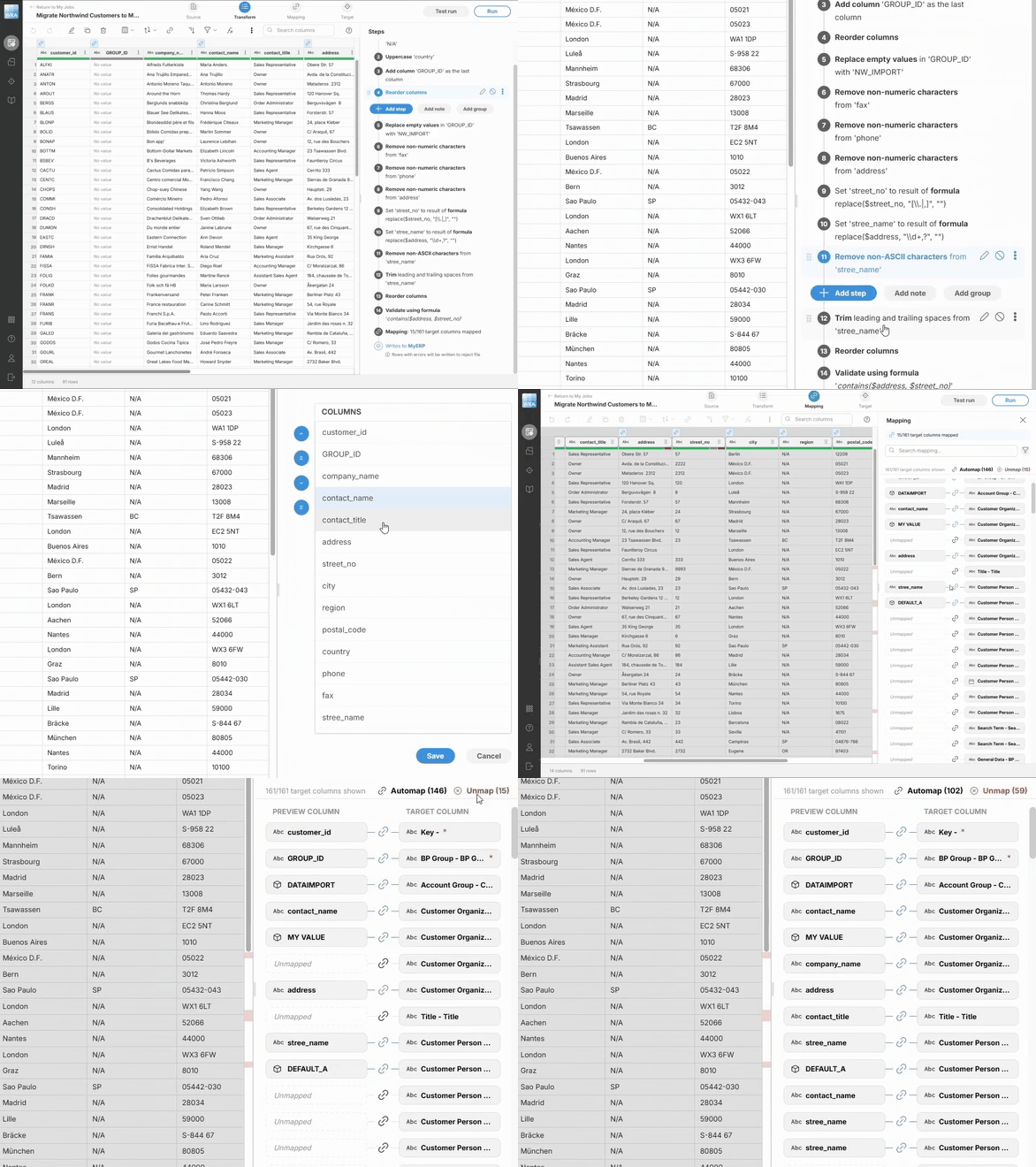
Enabling business users: CloverDX also enables both engineering teams and business users to work together – with user-friendly interfaces where business users can manage tasks such as data mapping or manual, human-in-the-loop error correction, and be fully integrated into solid, engineering built-and-led pipelines.
-
AI functionality: CloverDX has AI capabilities to help productivity and capabilities – from integration with both on-premise local AI models or third-party LLMs, to AI-powered acceleration for both developers and business users.
-
Error-handling: The platform handles errors at the record level, with configurable rejection routes – so unlike Boomi’s all-or-nothing batch failure behavior, one bad record doesn’t bring down an entire job.
-
Pricing: One of the main differentiators between Boomi and CloverDX is in the pricing model. CloverDX uses fixed licensing based on developer seats and server capacity – providing predictable, flat-fee pricing. There are no connector surcharges, no environment multipliers, and no consumption meters. For data teams whose volumes are growing, the platform cost simply doesn't grow with the data.
Consider CloverDX if: your primary use case is data integration and ETL rather than application connectivity, your data volumes are growing and consumption-based pricing is creating budget uncertainty, you need complex transformation logic and reliable per-record error handling, or deployment flexibility and infrastructure control matter to your organization.
Boomi vs CloverDX
Predictable pricing. Manage complex data pipelines. Scale when you like. See how CloverDX compares to Boomi.
Where CloverDX isn't a good fit as a Boomi alternative
CloverDX is not an application integration platform in the Boomi sense — if your primary use case is connecting SaaS apps in event-driven workflows, Boomi or Workato are better fits. But for data engineering teams running complex pipelines, doing large-scale data migrations, or processing high volumes with operational reliability requirements, CloverDX is worth evaluating.
2. Informatica Intelligent Data Management Cloud (IDMC)
Best for: Enterprise data governance, MDM, and cloud data management at scale
Informatica's cloud platform covers ETL/ELT, data quality, master data management, governance, and cataloguing under one umbrella — a breadth few competitors can match. For organizations with serious compliance requirements (GDPR, HIPAA, DORA), its lineage and MDM capabilities are particularly strong.
Compared to Boomi: Informatica is broader in data management scope but similarly expensive and arguably more complex to operate. Like Boomi, Informatica has been moving legacy PowerCenter customers to the cloud (IPU-based) pricing model, which can lead to significant cost increases.
Consider Informatica if: data governance and MDM are first-class requirements alongside integration — particularly in regulated industries where compliance tooling matters as much as the pipelines themselves.
3. Talend (now part of Qlik)
Best for: Teams needing data quality built natively into their ETL pipelines
Talend has a long history in data integration, and its data quality capabilities — built natively into the platform rather than bolted on — remain a genuine differentiator. It has a large existing user base with good community documentation.
Compared to Boomi: Talend's technical depth on transformations and data quality is strong. Where it's weaker is on the application integration and pre-built connector breadth that Boomi offers. The Qlik acquisition has also introduced some uncertainty about roadmap direction, and the transition to cloud-based pricing tiers has followed a similar pattern to Informatica — existing customers seeing costs rise.
Consider Talend if: data quality is a core pipeline requirement, your team has existing Talend expertise worth preserving, and you're comfortable with consumption-based pricing at scale.
Specialist and cloud-native tools
1. Fivetran
Best for: Automated data ingestion into cloud data warehouses
Fivetran does one thing exceptionally well: moving data from source systems into cloud data warehouses (Snowflake, BigQuery, Databricks, Redshift) with minimal engineering. Its fully managed connectors handle schema drift, API changes, and incremental loading automatically — a significant operational burden removed for analytics-first teams.
Compared to Boomi: It's a narrower tool — no application integration, no event-driven connectivity, and if you need to transform, route or trigger processes, then Boomi is likely a better fit. Fivetran’s Monthly Active Rows (MAR) pricing can escalate quickly on large tables or high-frequency syncs.
Consider Fivetran if: your primary need is automated, low-maintenance warehouse ingestion and you're comfortable using a separate tool for transformation and orchestration.
2. Microsoft Azure Data Factory (ADF) / Azure Integration Services
Best for: Organizations standardized on the Microsoft Azure stack
Within the Azure ecosystem, ADF's native connectivity (Azure SQL, Synapse, Fabric, Blob Storage, Dynamics) is unmatched. Its pay-as-you-go pricing can be cost-effective at lower volumes, and Microsoft's investment in Fabric has made the data integration story more coherent for analytics workloads.
Compared to Boomi: ADF is excellent within the Azure ecosystem but is notably weaker outside it. Non-Azure connectors often require more custom work, and managing pipelines at scale adds complexity. ADF and Logic Apps (for application integration) are separate products – the ‘integration services’ story is less cohesive than a single-platform iPaaS.
Consider ADF if: your organization is all-in on Azure and your data sources are predominantly in the Microsoft ecosystem.
Quick comparison: Boomi vs the alternatives
How to choose an alternative to Boomi: matching platform to use case
Rather than asking "which platform is best?", the more useful question is "which platform is best for my specific requirements?"
-
For SaaS application connectivity (Salesforce, HubSpot, NetSuite in event-driven flows) → Boomi, Workato, or Celigo. Workato wins on usability; Boomi on breadth; Celigo for mid-market ERP patterns.
-
For cloud warehouse ingestion (Snowflake, BigQuery, Databricks) → Fivetran for hands-off automated ingestion; CloverDX if you also need transformation depth and pricing certainty.
-
For complex ETL and data pipeline operations (high-volume batch, migrations, multi-step orchestration) → CloverDX or Talend. CloverDX's flat-fee pricing is particularly attractive as data volumes grow. Talend is worth considering if your team has existing expertise on the platform.
-
For data governance and MDM → Informatica, especially in regulated industries.
-
For Azure-native workloads → Azure Data Factory, particularly if Microsoft Fabric is in your roadmap.
-
Where pricing predictability is a top priority → CloverDX. Consumption-based pricing compounds as data grows; CloverDX's flat-fee licensing removes that variable entirely.
The bottom line on Boomi alternatives
Most platforms here are good — they're just good at different things.
Boomi is a capable, mature platform and for many organizations — particularly those needing broad SaaS connectivity with dedicated integration teams — it continues to deliver real value.
What’s the right Boomi alternative for you depends on your specific use case, team setup, budget structure, and how your data volumes are likely to evolve.
If you’re looking for a platform that offers powerful ETL capabilities, deployment flexibility, and the ability to have business users use visual interfaces alongside engineering-grade data pipelines, CloverDX is worth a look.
Interested in seeing how CloverDX handles your specific use case? Get in touch with the team or explore the platform to see how it compares for complex data integration workloads.
Want to see CloverDX in action?
Request a tailored demo to see how CloverDX compares to Boomi, or watch a short demo to explore CloverDX at your own pace.

Share