Data integration and data ingestion may sound similar, but they have one key difference. And it all comes down to the number of systems you're working with.
When you're working with combining data from multiple systems, it's data integration. But if you're just getting your data from X to Y, it's data ingestion.
Of course, we're only skimming the surface of what you need to know here.
Getting this distinction wrong isn't just academic. Teams that pick the wrong category up front often end up rebuilding a pipeline months later or paying for a heavyweight integration tool when a simple ingestion process would have done the job.
In this article, we'll be covering what each process means, running through a clear comparison of how they differ by scope, timing, and complexity, concrete examples of each in practice, how the two work together in a single pipeline, when it's time to automate, and which tools fit which approach.
Key takeaways
-
Data ingestion moves data from a source into a target system, while data integration combines data from multiple sources into one unified view.
-
The clearest way to distinguish the two: if you're combining data from multiple systems, it's integration; if you're just getting data from X to Y, it's ingestion.
-
Data integration is typically more complex than data ingestion, since it involves reconciling and combining datasets rather than simply relocating them.
-
Data onboarding is a related but distinct third term: it's about making incoming customer or client data usable, which can involve both ingestion and integration depending on the setup.
-
In most real pipelines, ingestion and integration aren't competing choices, ingestion happens first to bring data in, and integration follows to combine it into something usable.
-
A common rule of thumb for automation: if you need to do something four or more times, it's worth automating rather than repeating manually.
What is data integration
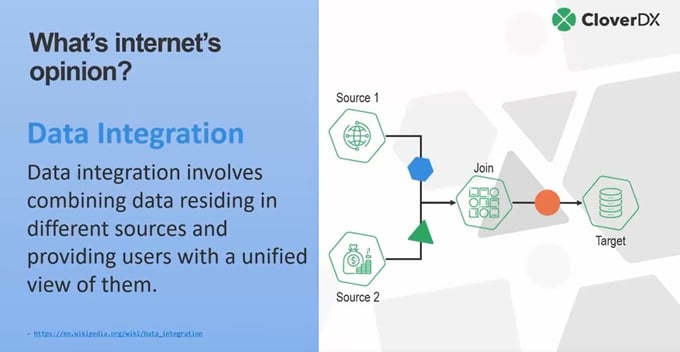
So, let's start with the definition of data integration:
'Data integration involves combining data residing in different sources and providing users with a unified view of them.'
- [Wikipedia]
This definition is very accurate. Data integration is often more complex than data ingestion and consists of combining data. Usually, you don't end up with two different data sets being pushed into a target, but rather a single data set that's augmented from multiple sources. These could be applications, APIs, or files.
The key difference here is that integration involves combining multiple sources together. A customer record enriched with data from your CRM, your support platform, and your billing system isn't three separate outputs, it's one, richer record. That distinction, one unified output versus several relocated ones, is what separates integration from ingestion at a structural level, not just a semantic one.
For the full picture of data integration specifically, read the guide: Data integration 101: Types of data integration, challenges and best practices.
Data ingestion
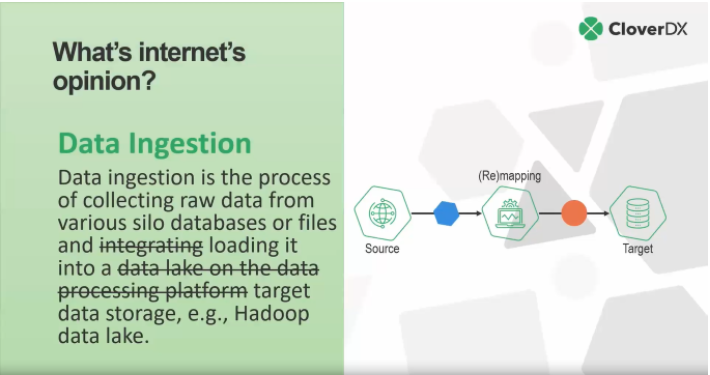
'Data ingestion is the process of collecting raw data from various silo databases or files.'
This definition is also very specific. You can collect data from any system, not just siloed databases or files.
If we were to reword this definition, we would instead state that data ingestion is the process of collecting raw data and loading it into a target data storage. It's important to note that the target doesn't have to be a data lake or warehouse. It could be anything, for instance, an e-commerce system like Shopify.
Essentially, data ingestion involves taking data from a source, remapping it to the target and ensuring the source and target can "talk" to each other, and then loading it to the target. For the specific features to look for in a dedicated tool, read the guide to data ingestion tools.
For the full picture of data ingestion specifically, read Data ingestion 101: Process, challenges and setting up a data ingestion pipeline that covers batch, streaming, micro-batch, and change data capture in depth, worth a read if you're deciding which fits your source systems.
Data ingestion vs ETLData ingestion vs data integration: Key differences
The clearest way to tell data ingestion and data integration apart is by scope, timing, and complexity.
|
|
Data ingestion |
Data integration |
|
Scope |
Moves data from a source into a target system |
Combines data from multiple sources into one unified view |
|
Timing |
Typically a repeated, ongoing process, can run in real time or batch |
Also ongoing, but often involves more processing time for reconciliation |
|
Complexity |
Adapts and loads data to the required format |
Must additionally resolve differences in structure, format, and meaning across sources |
That timing row is worth a closer look. Ingestion can be real-time or streaming (think transaction feeds arriving continuously) or scheduled in batches (think a nightly file drop), and this choice affects everything downstream.
None of these differences make one process more valuable than the other. A business that only ever moves data from one system to another has no need for the added complexity of integration and forcing it in anyway just adds risk without adding value. The right question isn't which one is better, it's which one matches what you're trying to do with a given dataset.
Data ingestion vs data integration: Real-world examples
Definitions only go so far. Here's what each process looks like when a business is running it at scale.
Data ingestion case study: Sisk Fulfillment Services
Sisk Fulfillment Services manages around 4.5 million shipments a year for dozens of clients. As the business grew, manual data validation and file processing became a bottleneck, this is a single-source problem repeated at huge volume, exactly the shape of a data ingestion challenge. By automating the ingestion of order data, Sisk moved from labor-intensive, late-night manual processing to faster, more reliable order handling with fewer errors, without needing to combine that data with other systems to get the benefit.
Data integration case study: Flight Centre
Flight Centre brings hundreds of thousands of customer travel profiles into its systems every year, from multiple different sources that need to be consolidated into one model, a genuine integration challenge, not just a movement problem.
The team also needed to migrate and transform millions of lines of data out of a closed vendor system to fit Flight Centre's own structure, and to pull data from multiple internal sources for regulatory and credit card reporting in different formats. CloverDX replaced Flight Centre's bespoke coded solutions with a low-code approach, cutting manual coding and maintenance effort while increasing visibility into the combined data.
Same underlying platform, two genuinely different problems: one about volume and repetition from a single source, the other about reconciling and combining several.
Where does data onboarding fit in?
A third term gets used alongside these two, and it's worth a brief distinction, is data onboarding. Where data ingestion is about moving data and data integration is about combining it, onboarding is about readiness, making a new client or customer's data usable for a specific business workflow, often for the first time.
FIA Tech, a financial services technology company servicing over 8,000 firms, is a good example of onboarding at scale. Their Trade Data Network needed to ingest data from market participants, sending information in wildly different formats, industry-standard FIX, flat files, XML, and turn each new participant into a working, standardized data feed as quickly as possible. The goal was to build generic processes that would serve not just the next 10 participants, but the next 100.
In practice, onboarding usually involves a mix of ingestion (getting the data in) and integration (making it consistent enough to use), which is exactly why the term gets bundled in with both. The practical difference for a buyer is that onboarding is framed around a customer-facing milestone, like getting a client live, while ingestion and integration are framed around the underlying systems problem.
How businesses approach data integration and ingestion
Most businesses don't start with a mature process for either ingestion or integration, they evolve into one as manual approaches stop scaling.
Early-stage data integration
As data integration is complex, many businesses use high-level programming languages, such as Python, PHP, and Perl as a starting point.
These languages are great as they have libraries and database connectors that make them easier to work with.
Businesses may also choose to embed cloud SDKs (software development kits) into their integration processes. These kits work easily alongside programming languages and cloud services, such as AWS S3 or Azure file storage.
However, while many businesses are apt at data integration, eventually cracks begin to appear.
Usually, this is a result of missing or outdated documentation. For instance, Person A built an integration years ago and then proceeded to leave the company without passing on the knowledge. This missing documentation and skills gap will ultimately create risk and result in incompetent data integration.
Initial approaches to data ingestion
A majority of data ingestion processes start manually through Excel spreadsheets or Google Sheets.
When these manual spreadsheets get too large to handle, however, businesses sometimes resort to bulk loaders. For instance, using something that allows you to put a file somewhere, where a script can then take it and upload it to a database.
This works well until the database gets too large. When that happens, businesses usually change the database. But the process of migrating the bulk loading scripts is difficult, to say the least.
Oftentimes, at this point, they may look for an ETL or ELT solution instead. This is where the question of automation comes into play.
How ingestion and integration work together in one pipeline
Framed as a choice, "which one do I need," ingestion and integration can sound like competing options. In most real pipelines, they're not, they're sequential stages of the same process.
Ingestion happens first, getting raw data from a source into somewhere you can work with it. Integration follows, combining that ingested data with everything else that needs to sit alongside it.
Flight Centre's setup is a clean example of this in practice. Data was first ingested from the legacy vendor system and from multiple internal sources, then integrated into Flight Centre's own unified model before it's usable for reporting.
Neither step alone would have solved the problem, ingesting the data without integrating it would have just meant several separate, disconnected feeds, while trying to integrate data that was never reliably ingested in the first place would mean building on an unstable foundation.
This is also where a single platform earns its keep over a patchwork of point solutions. If ingestion and integration run as two separate systems built by two different teams at two different times, the handoff between them becomes the weakest link, exactly the kind of undocumented gap that causes problems years later when the person who built it has moved on.
When is it time for automation?
As we've seen with both processes, there comes a point where the problems become too heavy to handle manually. Most businesses will find themselves firefighting more and more.
But when exactly is it time to embrace automation? Before we answer that, here's how we define automation at CloverDX. For a large audience, automation is an augmented manual process. But, for us:
💡 Automation is a completely autonomous process, which can run without any user intervention at all.
Many organizations adopt the "rule of four" for automation. Simply put, this rule states that if you need to do something four or more times, you should automate it. By automating repeated processes, you can save valuable time, weeks, months, or even years that you could spend focusing on higher-leverage tasks.
The rule works for data integration vs data ingestion. A one-off data ingestion job to backfill a legacy dataset probably isn't worth automating. A weekly ingestion feed from the same three clients, or an integration that runs every time a new order comes in, almost certainly is.
Tools for integration and ingestion
In regards to either data integration tools or data ingestion tools, you should evaluate adopting:
- Programmable web interface. These are very easy to configure and intuitive to use. Once you pay for a tool or register, you can use it straight away.
- Visual web designer. These are slightly more complex, but often component-based. In essence, you just wire together these pre-programmed components to help you build a transformation.
- IDE (Integrated Development Environment). Usually, you install these tools locally. Much like visual web designers, they hinge on a component-based approach. But they offer more advanced programming tools and will require more skilled users to operate.
- Programming frameworks. You can also adopt programming libraries to work and program your data flows (and can also use these in IDEs). However, these have fewer visual aids and drag and drop features. So, once again, this solution is more apt for technical staff.
Any of these options work, but your choice will be dependent on the skills you have available and your unique business needs. It's also worth remembering that these categories aren't mutually exclusive over the lifetime of a project, a team often starts with a programmable web interface for something quick, then moves toward a visual designer or IDE as the same process grows more demanding.
How CloverDX supports data ingestion and integration
While data ingestion and integration may only have one key difference, the two processes can produce a variety of different challenges, and those challenges become more apparent the bigger your project becomes. If you rely on manual processes for either, you risk falling into the trap of human error, lost documentation, and wasted resources.
This is exactly the failure pattern described earlier: an integration or ingestion process that works fine for years, then becomes a liability the moment the person who built it moves on. The fix isn't necessarily more oversight, it's a platform where the process itself carries its own documentation.
CloverDX is built to span more than one of the tool categories above at once. Instead of forcing a choice between a visual designer and a full coding environment, CloverDX gives you the option of both in the same platform, so a simple ingestion job and a complex, multi-source integration, or an onboarding process that needs both, can be built, run, and maintained without switching tools as your needs evolve from one to the other.
This matters most as projects grow, automating what used to be manual, whether that's application integration across multiple systems or straightforward data ingest from a single source, keeps the documentation and knowledge in the platform itself rather than in one person's head. A visual graph is something the next person can open and understand in minutes, not something they have to reverse-engineer from undocumented code.
Final thoughts: Complementary processes, not competing ones
Data ingestion and data integration aren't rivals for the same job, they're different tools for different scopes, and often different stages of the same pipeline. Ingestion gets data from A to B; integration combines it into something more useful than the sum of its parts. Getting the distinction right upfront is what stops you from rebuilding the wrong kind of pipeline six months in.
Whether you're moving data from A to B or combining it from hundreds of sources, the right platform shouldn't force you to choose. Let's talk about what that looks like for your team.
Watch the full webinar
While data ingestion and integration may only have one key difference, the two processes can produce a variety of different challenges.
These challenges become apparent the bigger your integration or ingestion project becomes.
If you rely on manual processes for either, you risk falling down the trap of human error, lost documentation, and wasted resources. So, we recommend adopting automation wherever you can.
There's more detail on data ingestion, data integration, and how to approach each one in the full video: Data Ingestion vs Data Integration: What's the Difference?

Share