
Healthcare providers and healthcare technology companies both face a serious data challenge. The industry is in the middle of an information boom, generating more data than almost any other sector, but there's a persistent gap between collecting that data and using it. The volume of healthcare data keeps growing, but it isn't getting any less complex or variable.
Whether you're a hospital system trying to make sense of records from a dozen different providers, or a HealthTech company trying to onboard your hundredth client with its own data quirks, the underlying challenge is the same: turning inconsistent, high-stakes data into something people can use.
In this article, we'll be covering what healthcare data integration involves, why it's uniquely difficult compared to other industries, the standards behind healthcare data exchange, the most common challenges, real examples of these challenges being solved, and the distinct version of this problem HealthTech companies face specifically.
Key takeaways
-
Healthcare data integration combines data from EHRs, insurers, benefits administrators, and other sources into a unified, usable view, and both healthcare providers and the HealthTech companies serving them face this challenge directly.
-
HL7v2 remains widely used in healthcare data exchange, but FHIR, built for API-driven, real-time exchange, is becoming the modern standard for cloud and mobile healthcare solutions.
-
A lack of data standardization across providers is one of the most common causes of duplicate records, integration failures, and inaccurate insights in healthcare data.
-
Separating data mapping rules from the technical pipeline itself lets clinical and business domain experts contribute directly, without needing developer skills.
-
HealthTech companies face a distinct version of this challenge: onboarding many different healthcare organizations, each with its own data quirks, without scaling headcount in step with growth.
-
EHR migrations carry real risk of data loss if not carefully managed, making templated, auditable migration workflows essential rather than optional.
What is healthcare data integration?
Healthcare data integration is the process of combining data from electronic health records, insurers, benefits administrators, labs, and other sources into a unified, accurate view.
For healthcare organizations, this is hugely important for patient care. A clinician working from a fragmented record is working with an incomplete picture, and a payer or administrator reconciling data from multiple systems risks costly errors.
For HealthTech companies, integration is often the product itself, the ability to reliably combine and standardize data from every client's system is what makes the platform useful, and it's often the difference between a client that stays and one that doesn't.
The two audiences experience the same underlying problem from different angles. A provider is usually trying to integrate data that already exists inside its own walls, spread across departments and legacy systems. A HealthTech company is usually trying to integrate data that arrives from outside, from every client it serves, each with a slightly different version of the same standard formats.
Both end up solving variations of the same challenge, just at different scales and from different starting points.

Why healthcare data integration is uniquely difficult
Healthcare data integration is harder than in most industries because the data itself is unusually variable, and the stakes of getting it wrong are unusually high.
The biggest data challenge the healthcare industry faces is translation. There's a modern-day Babel of data formats that have to be parsed. Despite gathering a significant amount of information under the HL7 umbrella, or HL7v2 more specifically, individual providers still have their own data-collection idiosyncrasies that tweak the parent format and make a one-size-fits-all approach to processing impossible. Add the fact that HL7 is an incredibly complex format even without that variability, and the difficulty of turning raw data into actionable medical insights becomes clear.
It's also unreasonable to expect healthcare professionals to master data science on top of their medical expertise. Information needs to serve medical practitioners without requiring that they learn to work with data on a technical level, and unlike in finance or marketing, the stakes here are, quite literally, life or death.
This combination, high-stakes data, inconsistent formatting, and a workforce that shouldn't need technical training to do their actual jobs, is what sets healthcare apart from most other industries wrestling with data integration. A marketing team can tolerate a data error for a day while it gets fixed. A clinical team often can't.
HL7 and FHIR: The standards behind healthcare data exchange
HL7 (Health Level Seven International) has published the standards behind healthcare data exchange for decades. HL7 versions are the long-established messaging format most healthcare systems still rely on, and FHIR is the newer API-driven standard built for real-time, cloud-native exchange.
HL7 and FHIR remain two distinct, actively maintained standards from HL7 International, not one merged standard. HL7v2 is the long-established messaging format most clinical systems still run on; in practice, v2.5.1 remains the most widely deployed and mandated version in real-world clinical operations, even though v2.9 (2019) is the final release in that line. FHIR (Fast Healthcare Interoperability Resources), developed by the same standards body, is built for exactly the API-driven, real-time data exchange designed to support cloud, mobile, and increasingly AI-driven healthcare applications.
FHIR is a fundamentally different, API-driven standard, and it's still actively evolving. FHIR R5 (2023) is the latest fully published release, but R4 remains the primary baseline enforced by regulators like ONC and CMS, with R6 now moving through ballot.
Plenty of healthcare data exchange today still runs on HL7v2, and it will for some time, but any organization planning for where healthcare data is headed needs a strategy that can work with both, not just the standard that's currently most common.
The pragmatic position is treating both as first-class citizens in your integration strategy, rather than betting entirely on one standard outlasting the other.
Common healthcare data integration challenges
Most healthcare data integration challenges come down to variability, compliance, and the gap between technical and clinical teams.
-
Format variability: even within a single standard like HL7v2, individual providers introduce their own quirks, making a single, universal processing approach impractical.
- Compliance requirements: HIPAA and similar regulations shape nearly every integration decision, from how data is stored to who can access it.
Legacy systems: many healthcare organizations run on dated, on-premise systems that were never built to communicate with newer cloud-based platforms. -
The technical-clinical gap: the people who understand what healthcare data means are rarely the people equipped to write the code that processes it, and building a bridge between the two is often harder than the technical work itself.
None of these challenges exist in isolation. A legacy system that can't communicate with newer platforms compounds the format variability problem, since there's no shared modern layer to standardize against.
Compliance requirements make it riskier to work around either problem with quick, informal fixes. The organizations that manage this well tend to address all four together, rather than solving one and assuming the rest will follow.
How CloverDX-based data mapping helps Diameter Health onboard customers more quicklyHealthcare data integration in practice: Real use cases
Here's what solving data challenges in Healthcare looks like, drawn from real healthcare and HealthTech implementations.
Maintaining clinical data continuity through multiple concurrent transitions
A large US pediatric health provider runs CloverDX Server as the integration backbone of its analytics estate, extracting and transforming legacy EMR data from clinical systems into an on-premise data warehouse.
That pipeline had to stay stable through three concurrent changes at once: a transition between IT services providers, an Epic EHR implementation, and the stand-up of an entirely new BI engineering team. Server diagnostics and job monitoring meant that new team could troubleshoot the pipeline directly, without needing deep platform expertise built up over years, exactly the kind of continuity that matters when so much else is changing simultaneously.
That same foundation is now supporting the organization's move to Microsoft Fabric. CloverDX handles the complex legacy extractions and historical data migration this requires, enabling a phased cutover rather than forcing a single, high-risk switchover.
Processing variable and high-volume clinical data
A CloverDX client works with large-scale healthcare data to make it actionable. Their process is straightforward: take HL7 messages, transform them into a standard JSON format, then load that into their analytic warehouse. But variability in formats and versions, and the fact that mapping requires input from domain experts who don't necessarily have developer skills, meant they needed support.
To resolve this, the mapping and transformation rules were separated from the execution data pipeline itself, with straightforward, easy-to-understand representations for expressing those rules in a format domain experts were already comfortable with, in this case, Excel.
Here's a diagram to show what the mapping looked like:
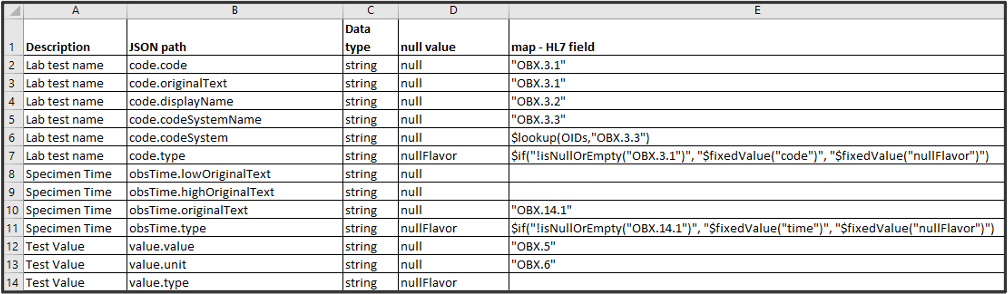
Once the mapping documents exist, they run inside the data pipeline: HL7 data comes in, gets translated to a raw JSON format, then the mapping runs, grabbing the appropriate Excel document, performing the required mapping, and creating a new JSON file ready for downstream processing. This approach isn't just accessible to domain experts, it's extensible too, able to take any message, convert from any flavor of HL7, apply a custom mapping, and create an output file, running on autopilot as new messages arrive.
Watch a demo of the process in CloverDX:
Automating ingest of healthcare plan descriptions
A US-based health insurance provider uses CloverDX to simplify the process of employers choosing which plans to offer their staff by collecting and analyzing insurance plan descriptions on their behalf, giving employers more control over both cost and compliance.
The challenge was automatically processing these plans: they arrived as spreadsheets not well-optimized for a computer to read, and the plans would frequently change, new columns, new rows, and so on.
You can see how complex these spreadsheets can get:
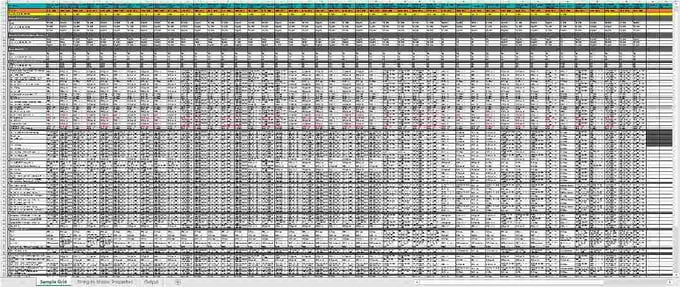
The five-step automated solution looked like this: analyze the plan description spreadsheet to establish its structure, read the spreadsheet and extract the data, enrich it with additional data, translate the plan description into fully qualified JSON, and upload the data to the warehouse.
The client can now automate the process of extracting plan descriptions, making accurate, up-to-date information available to their own clients.
Watch a more in-depth explanation of this use case:
Automated processing of healthcare benefits enrollment
Another CloverDX client manages benefits enrollment activity for employers, specifically the process of people filling out forms to change their coverage, acting as an intermediary between healthcare consumers and the insurance provider.
Automating this data pipeline meant establishing a series of enrollment events: accept events in the form of EDI 834 formatted messages, the standard for healthcare benefits enrollment transactions; validate the message format, returning invalid messages for correction; and process valid messages by comparing them against current records and dispatching valid requests to the associated insurance company.
Automated audit reports ran alongside this, so the client can see which requests were accepted or rejected, and exactly what changed.
Thanks to automation, the client can now handle more business without scaling their headcount to match.
Watch the video for a walkthrough of this solution for automating the management of benefits change requests:
EHR data migration
An organization that provides integrated healthcare technology solutions to medical practices, covering everything from practice management to EHR (Electronic Health Records) software, was faced with the challenge of migrating medical practices to a new EHR system.
The solution depended on the accurate onboarding of clients and moving them quickly and accurately from legacy EHR systems to the client's own platform.
To optimize these migrations, the HealthTech organization used CloverDX to template workflows built for source EHR systems. These workflows let existing staff handle more data migrations while reducing errors, and making re-migrations faster if an initial migration exposes data issues that need a re-run. Automatic audit reports were built in alongside these templated workflows, improving customer confidence that each migration went well.
The final video clip describes how the architecture built with CloverDX worked to create faster, more efficient data migrations, and to enable the same process to be used for migrations from different systems.
HealthTech SaaS providers: A distinct challenge
HealthTech companies face a distinct healthcare data integration challenge: onboarding many different healthcare organizations, each with its own data quirks, without scaling headcount to match.
A single hospital system integrating its own internal data has one set of format quirks to solve for. A HealthTech company serving a hundred hospital systems has a hundred sets, multiplied, and every new client is a race against the clock, since the faster a client can be onboarded, the faster they start seeing value, and the sooner the relationship pays for itself.
This changes what "good" integration tooling looks like for a HealthTech vendor. A provider can often justify a bespoke, one-time integration project for its own systems. A vendor onboarding dozens or hundreds of clients can't repeat that bespoke effort every single time without the business model breaking down, engineering time spent re-solving the same problem for each new client is engineering time not spent improving the product itself.
Diameter Health uses CloverDX to turn raw clinical data into something healthcare experts can use. They regularly face massive variability in how their own clients, healthcare providers, manage HL7v2, and deployed CloverDX as a leveler, transforming that data into a standardized JSON stream their non-technical clients could work with directly.
The EHR migration provider covered above is another good example of the same faster data onboarding approach that helps that company scale to dozens of practices without a linear increase in engineering headcount. Templated, reusable workflows aren't just an efficiency nicety for a HealthTech company, they're often the difference between a business model that scales and one that doesn't.
The common thread across both examples is giving domain experts and business users direct input into how data gets mapped and standardized, rather than routing every client's quirk through a developer team that becomes the bottleneck to growth.

Final thoughts: Turning complex data into something usable
Healthcare providers and HealthTech companies face different versions of the same underlying problem: data that's variable, high-stake, and often needs to be understood by people who aren't, and shouldn't need to become, data specialists.
The organizations that solve this well are the ones that build for that reality, standardizing formats, involving domain experts directly, and automating the repetitive parts, rather than treating each new data challenge as a one-off problem to solve from scratch. CloverDX healthcare and health insurance solutions cover whichever side of the challenge you're looking to solve.
Whether you're a healthcare organization or a HealthTech company, solving your data challenges shouldn't require becoming a data specialist yourself. Let's talk about how CloverDX can solve your complex data challenges.
Healthcare data management with CloverDX

Share