
As AI increases the demands placed on data operations, maturity can no longer be measured by capability alone. The next stage of data maturity is the ability to absorb change without adding proportional effort, complexity, and risk.
Many data operations now have the features we have traditionally associated with maturity. Teams are established, processes are more formal, pipelines are reliable, and business stakeholders are more engaged in setting priorities.
The difficulty is that those strengths do not always translate into an operating model that can respond easily when demand changes. A new source, customer requirement, or AI use case can still trigger a disproportionate amount of manual work, delay, and risk.
Key takeaways
- Data maturity isn't about capability anymore. It's being outgrown as AI raises the demand on data operations faster than teams can absorb it.
- The question has shifted from "does the operation work today?" to "does it get easier to extend as demand grows?", which means absorbing change over just delivering data.
- Capability and scalability have split: 86% of stakeholders understand data work well, yet 72% of organizations still deprioritize change requests because of system constraints.
- AI doesn't create new weaknesses. It exposes existing ones, when a workflow needs to be monitored, changed, governed, or recovered. This is the AI control gap.
- Automation and reuse separate scalable teams from the rest. Automation-first teams are 3.9x more likely to be confident they can scale.
- Watch for the maintenance trap: bespoke work per request, rebuilt workflows, knowledge stuck with individuals, and controls sitting outside the pipeline.
- Getting AI-ready comes down to three disciplines: reduce uncontrolled manual work, build battle-tested reusable workflows, and bake quality, control, and observability into delivery from the start.
Our recent research report Rethinking Data Maturity in the Age of AI found that 86% of stakeholders understand data work fairly well or very well, and 77% collaborate with data teams. At the same time, 72% of organizations still deprioritize change requests because of system constraints.
This combination shows that many organizations have built the capability to deliver data, but fewer have built an operating model that can absorb more demand without becoming harder to change. For data leaders, that is the next stage of maturity to focus on.
Capability is only part of the picture
Traditional data maturity models tend to ask whether the right foundations are in place. Does the organization have a dedicated data team? Are processes documented? Are pipelines dependable? Is the business involved? Are the right tools available?
Those questions still matter. Without those foundations, it is difficult to support serious data or AI ambitions. The problem is that they do not tell us enough about how the operation behaves under pressure.
A team may be perfectly capable of delivering a new pipeline, but every request may still require another bespoke process. A platform may be reliable in its current state, but difficult to change without creating uncertainty downstream. Business stakeholders may be engaged, but the team may not have the capacity to respond at the pace they expect.
This is becoming more important because the volume and variety of demand is increasing.
Data teams are being asked to support more sources, more customer requirements, more use cases, and more frequent changes. AI is adding to that pressure, with 74% of organizations ranking AI-assisted development among their top investment priorities over the next 12 to 24 months. As it becomes easier to generate code, create workflows, and move from idea to implementation, the operating model underneath that work has to absorb more change at a faster pace.
The next stage of maturity, therefore, depends on more than delivery capability. It depends on whether the operation can keep absorbing change without becoming slower, more fragile, or more expensive to maintain.
Traditional maturity vs AI-era maturity
This is the core of what data leaders need to account for. The measure of maturity is shifting from whether the data operation works today to whether it becomes easier to extend as demand increases.
Your AI is only as good as your data operation
The hard part isn't launching AI, it's running it when something breaks. This report shows what your operation needs first.

AI is making existing constraints more visible
AI has made many weaknesses in enterprise data operations harder to ignore.
A team that already relies on manual validation, undocumented knowledge, or fragile integrations may still be able to launch an AI-enabled workflow. The difficulty often appears later, when that workflow needs to be monitored, changed, governed, or recovered after something goes wrong. This is the AI control gap.
The same is true of data quality. A problem that once affected a single report may now influence an automated process, a customer-facing system, or an AI-assisted decision. The issue is no longer contained within one team or one output.
As AI becomes more deeply embedded in data and engineering work, leaders need to understand whether the underlying operation can support it reliably. They need to know whether data can be trusted, whether dependencies are visible, whether failures can be recovered quickly, and whether human review is built into the right points of the workflow.
They also need to know whether each new use case is adding durable capability or simply another layer of complexity.
Scalability is becoming the stronger test of data maturity
A useful way to assess data maturity is to look at what happens when demand increases.
Does the operation become easier to extend, or harder to change?
In a less scalable environment, every new requirement creates another piece of bespoke work. Each decision may be reasonable in isolation. Over time, however, the accumulation begins to shape the way the entire operation works.
More effort goes into maintaining what already exists. Teams become more cautious because the downstream impact of change is unclear. Experienced people spend more time supporting fragile workflows and less time improving the system, getting stuck in the maintenance trap.
A scalable operation reduces that pattern. New requirements can be supported using components and workflows that have already been tested, documented, and proven in production. Quality checks, monitoring, and recovery are built into delivery. Business and domain experts can review exceptions or approve sensitive actions inside controlled workflows.
Our research found that automation and reuse are two of the clearest differences between scalable organizations and the rest. Automation-first teams are 3.9 times more likely to be confident in their ability to scale, because they can move faster without relying on the same level of bespoke work each time demand changes.
That is a more useful measure of maturity than the presence of a team, a platform, or a documented process on its own.
What holds organizations back from the next stage of data maturity
Data leaders do not need to discard the maturity measures they already use. They need to extend them beyond delivery capability and ask how well the operating model absorbs change, reuses proven workflows, embeds quality and control, and avoids creating new effort each time demand increases.
A good starting point is to examine where the operating model creates unnecessary effort or dependency:
-
New requests create separate delivery problems. If every source, customer requirement, or use case needs a bespoke process, the operation will struggle to scale regardless of how experienced the team is.
-
Similar workflows are repeatedly rebuilt. Repeated reinvention often points to limited reuse, unclear ownership, or a lack of trusted patterns that teams can adapt.
-
Critical knowledge sits with individuals. If one person is needed to change, recover, or interpret a workflow, that dependency becomes a constraint even when the process appears reliable day to day.
-
Quality and control sit outside the workflow. Checks are easier to miss or bypass when delivery pressure rise
Finally, leaders should look closely at how much team capacity is being consumed by maintenance. A team that spends most of its time preserving existing systems will have less room to automate, modernize, or support new AI-enabled work.
Moving toward AI-ready scale
The next stage of data maturity depends on how well the operating model reduces avoidable effort, strengthens repeatability, and builds trust into the workflow itself.
Our report identifies three operating disciplines that matter most.
-
Reduce uncontrolled manual work. Human expertise remains essential, especially where judgment, approval, and exception handling are required. The risk comes when those steps sit outside shared workflows, depend on individual knowledge, or happen through disconnected spreadsheets, emails, and informal checks.
-
Build battle-tested reusable workflows. As AI makes it faster to generate code and workflow logic, organizations need proven patterns they can adapt with confidence. Reusable ingestion, validation, transformation, recovery, and exception-handling processes help teams move faster without creating more one-off variation.
-
Build quality, control, and observability into the workflow. AI-ready data operations need quality checks, governance, monitoring, recovery, approval, and auditability to be part of delivery from the start. These controls help teams move quickly while preserving visibility and accountability.
Taken together, these disciplines help data teams support more demand without adding the same level of manual work, delay, and risk. They also give leaders a clearer way to assess whether their current operation is ready for AI-era scale.
Get our latest research report for free
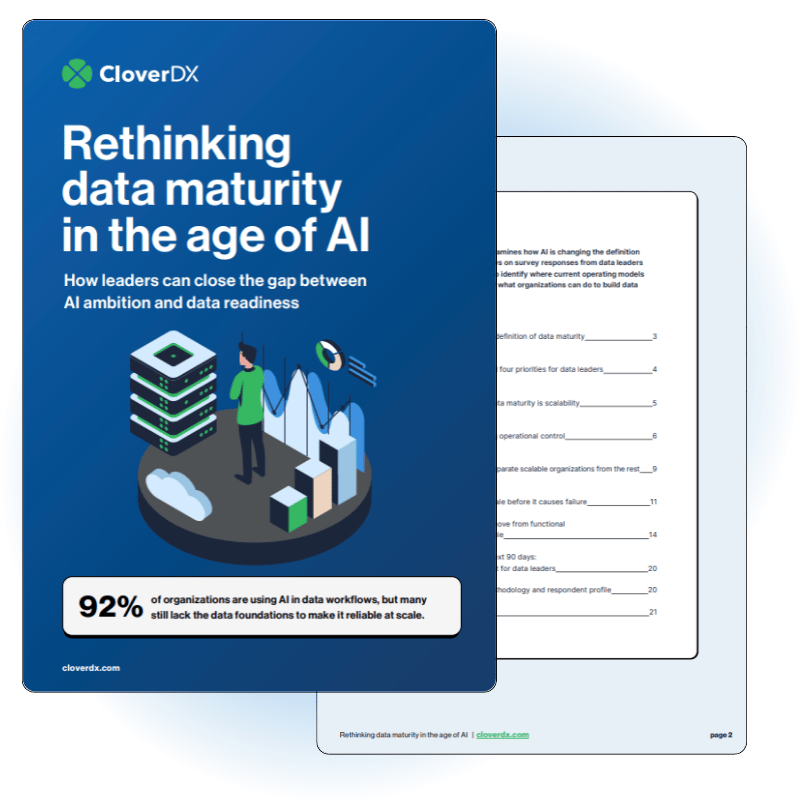
Our new report, Rethinking Data Maturity in the Age of AI, examines where current operating models are beginning to strain, what separates scalable teams from the rest, and how leaders can assess their own path toward AI-ready data maturity.
Download the report to explore the full findings and see where your organization stands.
Want the full picture?
Download the full report based on insights from 200+ data leaders, to see what it takes to scale your data operations in the age of AI.

Share